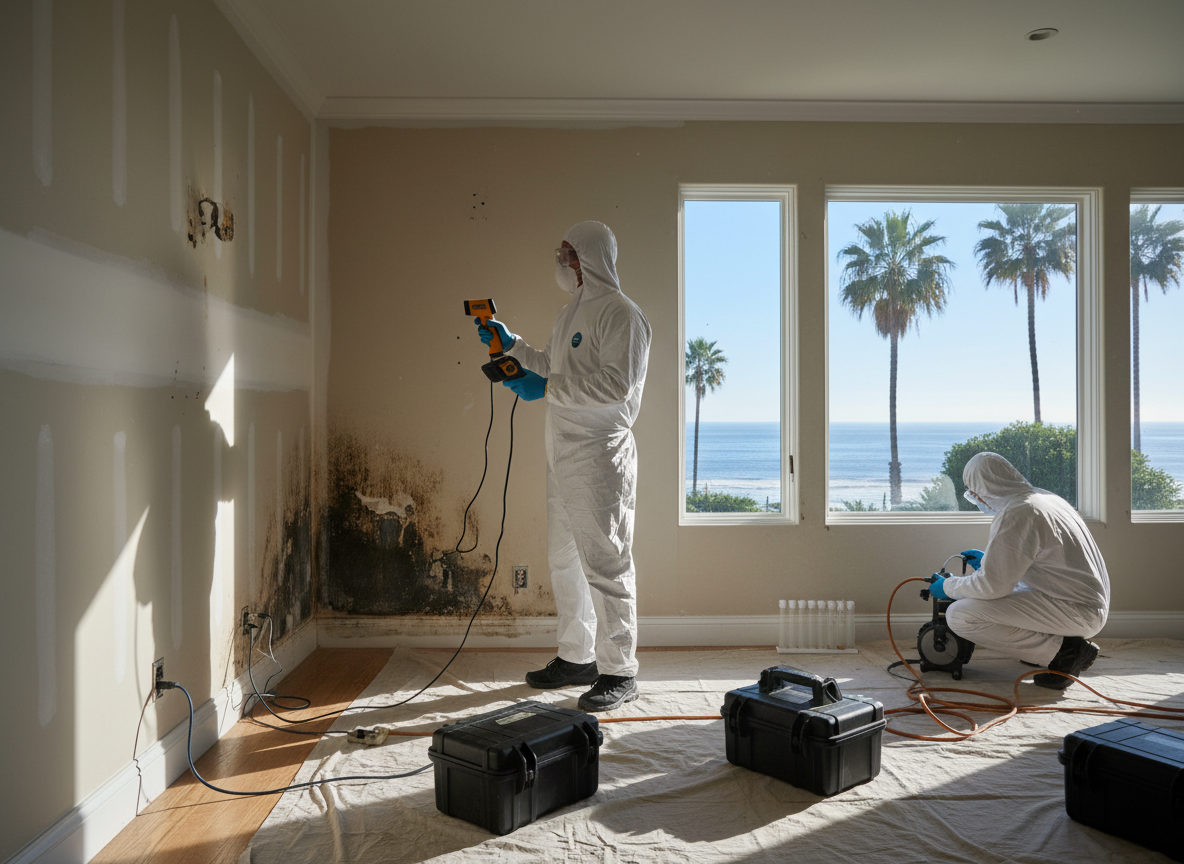
Pacific Palisades sits in Los Angeles County with many homes built before 1970 in neighborhoods like The Village and Marquez Knolls. These older structures often feature crawl spaces and attics that trap moisture from the mild coastal Mediterranean climate and its frequent foggy mornings. A proper inspection starts with moisture mapping using meters and thermal imaging to locate condensation points that homeowners rarely notice until odors appear. Inspectors also check around Pacific Palisades Park and Temescu Park where irrigation runoff can seep into foundations on sloped lots.
Castellammare properties sit closer to the ocean and experience higher humidity that travels through stucco cracks common in mid-century construction. During inspection we pull baseboards in suspect rooms, lift carpet edges, and sample air in living spaces versus crawl spaces to compare spore counts. This step reveals whether growth has crossed into HVAC systems that run constantly during Santa Monica and Malibu heat spells. Documentation includes photos and lab results that guide any later remediation without guesswork.
Terrain in the area creates access challenges on steep driveways and hillside lots near Will Rogers State Historic Park. Inspectors carry portable equipment up narrow paths and work around mature landscaping that can hide exterior water intrusion points. We also note any recent roof work or window replacements that may have introduced new leak paths during the foggy season when drying takes longer than inland Los Angeles County locations.
Technician insight
In Pacific Palisades the thing that catches most people out with Mold Inspection is the way morning fog lingers in the canyons around Marquez Knolls and Castellammare, keeping older stucco walls damp long after the sun comes out. Homeowners assume a quick visual check is enough, but we routinely find growth behind baseboards where the hillside lots trap runoff that never fully dries.
Hidden Growth Behind Guest Bathroom Wall
A Castellammare homeowner noticed a musty smell after several foggy weeks but saw no visible spots. We mapped elevated moisture along the shared wall with the garage, pulled a small section of baseboard, and confirmed active growth in the drywall. Samples confirmed the species, and the report outlined the exact area needing removal before any remediation started.
How it works
- 1
Site Walk and Moisture Survey
We begin at the address on Monument Street and move through every accessible area, checking walls, ceilings, and floors with calibrated meters while noting construction type and recent weather exposure.
- 2
Air and Surface Sampling
Samples are collected from multiple rooms plus the exterior for comparison, then sent to a lab to identify mold types present in Pacific Palisades homes.
- 3
Report and Scope Review
Findings are compiled into a written report with photos and recommendations that the homeowner can review before any remediation work is discussed.
Pricing
Inspection cost depends on square footage, number of samples, and access difficulty; we provide an upfront quote after the initial phone description of the property.