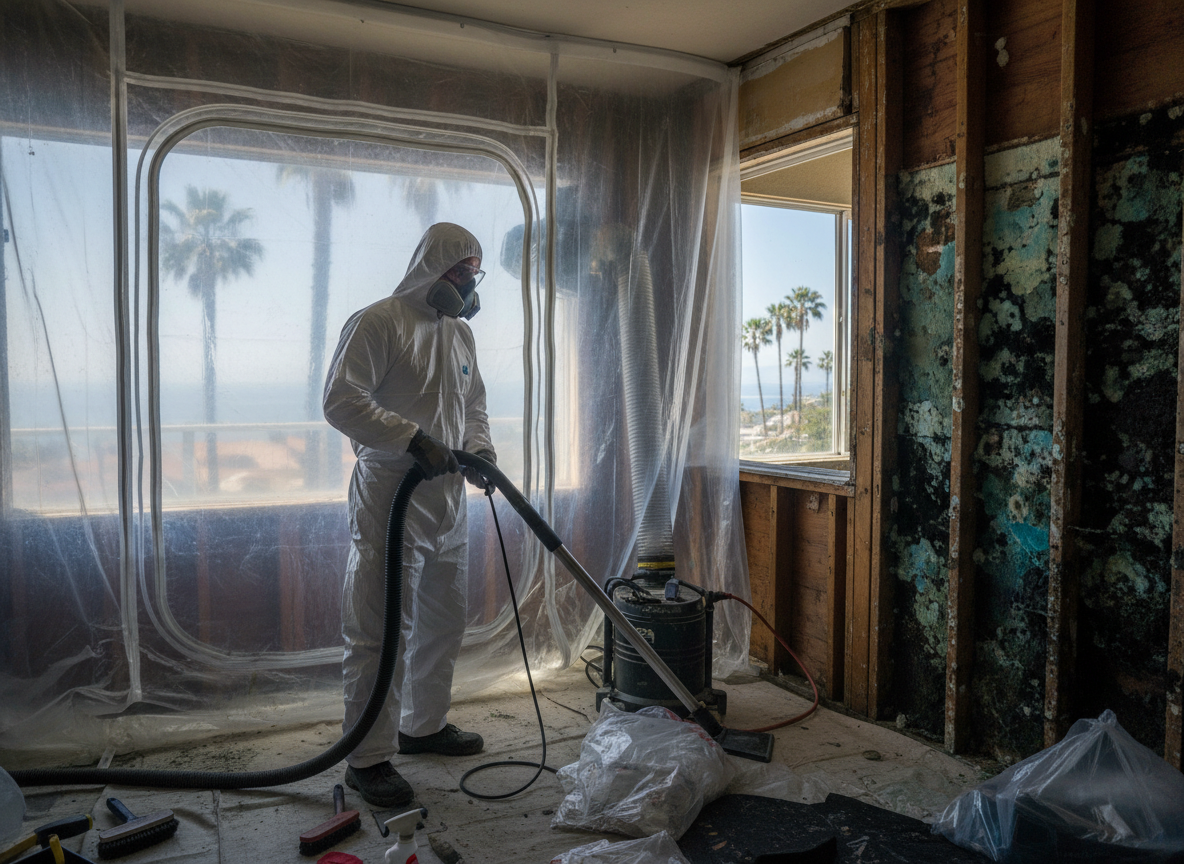
Pacific Palisades homes built on slopes in Castellammare and Marquez Knolls often have crawl spaces and basements that stay damp from the mild coastal Mediterranean climate and recurring foggy mornings. These conditions let black mold colonies establish on framing and insulation before homeowners notice musty odors or ceiling stains. Our crews map moisture with infrared cameras and air sampling, then isolate affected sections so spores do not drift into living areas during removal.
Los Angeles County building practices from the mid-century era left many Village and Castellammare residences with single-pane windows, unvented bathrooms, and stucco that holds water after winter rains. When leaks occur near Will Rogers State Historic Park or Temescu Park properties, mold frequently travels behind drywall into adjacent rooms. We cut out contaminated material at least eighteen inches past visible growth, bag it on site, and run negative-air machines until clearance testing confirms levels are safe for re-occupancy.
After removal we address the source by improving drainage around foundations and recommending exhaust fans that vent directly outside rather than into attics. Homes near Pacific Palisades Park face additional risk from wind-driven fog that condenses on north-facing walls, so we check those surfaces even when the visible problem is elsewhere. This step-by-step approach keeps the job contained and prevents repeat growth common in the area.
Technician insight
In Pacific Palisades the thing that catches most people out with toxic mold removal is how the daily fog from the coast keeps soil and crawl spaces under older Castellammare homes damp year-round, so the mold returns within months if we only treat the visible patch and skip the drainage fix.
Hidden growth after bathroom leak in The Village
A homeowner noticed a ceiling stain after a slow shower leak. Inspection revealed black mold extending three feet into the attic and down the shared wall with the next room. We contained the second floor, removed the affected drywall and insulation, dried the framing, and confirmed clearance with air tests before reinstalling finishes.
How it works
- 1
Site Assessment
Technicians inspect all suspect areas with moisture meters and borescopes, documenting growth extent in crawl spaces, attics, and wall cavities.
- 2
Containment Setup
Plastic barriers and negative air machines isolate the work zone so spores stay out of occupied spaces during demolition.
- 3
Material Removal
Contaminated drywall, insulation, and wood are cut out, double-bagged, and removed while HEPA vacuums capture airborne particles.
- 4
Drying and Clearance
Dehumidifiers and air movers dry the structure, followed by post-remediation air and surface sampling before barriers come down.
Pricing
Cost depends on square footage affected, access difficulty in hillside homes, and whether structural wood must be replaced.