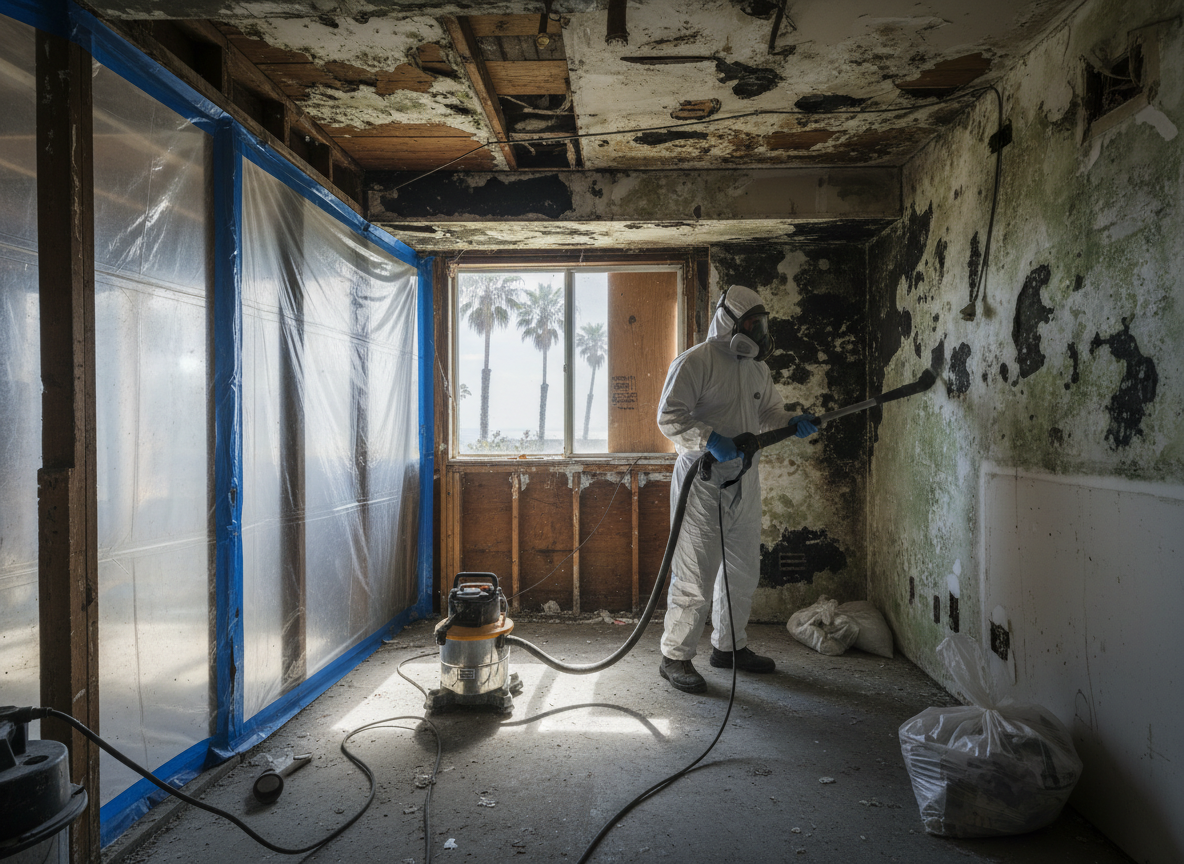
Pacific Palisades sits in Los Angeles County with a mild coastal Mediterranean climate where foggy mornings routinely raise indoor humidity in older homes. Many properties in Castellammare and Marquez Knolls date from the 1950s and 1960s with crawl spaces and attics that trap moisture against stucco and wood framing. Mold abatement here starts with identifying hidden growth behind plaster or under floorboards near Temescu Park and Pacific Palisades Park, where irrigation runoff and salt air accelerate decay. Technicians must separate living spaces from work zones to prevent spores from drifting toward Will Rogers State Historic Park trails or neighboring Santa Monica residences.
Abatement crews use negative air machines and HEPA filtration sized for the tight lots common in The Village. Porous materials like drywall and insulation are removed when moisture content exceeds safe thresholds after the morning fog lifts. In homes near Malibu borders, crews also check for water intrusion from hillside drainage that funnels into basements during rare winter rains. Containment barriers stay in place until post-remediation testing confirms spore counts match outdoor baselines from the Pacific Palisades Park area.
Final steps include drying affected framing with dehumidifiers calibrated for the local salt air and applying antimicrobial coatings only where code allows in Los Angeles County structures. Homeowners in Marquez Knolls often overlook HVAC ducts that pull in damp air from foggy mornings, so those systems receive separate cleaning. All debris leaves the site in sealed containers to avoid spreading spores along Sunset Boulevard routes.
Technician insight
In Pacific Palisades, the thing that catches most people out with mold abatement is the foggy mornings that keep crawl spaces in Castellammare homes damp long after the sun appears. Homeowners often seal the vents thinking it stops moisture, but that traps the salt air and lets growth spread along sill plates before anyone notices.
Hidden Growth Behind Kitchen Cabinets
A Marquez Knolls homeowner noticed a musty smell after several foggy weeks. Inspection found mold on the back of cabinets where a slow roof leak met morning condensation. Crews removed the affected drywall and insulation, dried the framing, and confirmed clearance before reinstalling finishes.
How it works
- 1
Initial Assessment
Technicians inspect attics, crawl spaces and wall cavities in Pacific Palisades homes using moisture meters and borescopes to map growth without disturbing spores.
- 2
Containment Setup
Plastic barriers and negative air machines isolate the work area so spores do not reach unaffected rooms or drift toward nearby Santa Monica properties.
- 3
Material Removal
Contaminated drywall, insulation and wood are cut out and bagged on site, then transported for proper disposal under Los Angeles County guidelines.
- 4
Drying and Treatment
Industrial dehumidifiers and air movers dry remaining surfaces while antimicrobial agents are applied to framing where permitted.
- 5
Clearance Testing
Air and surface samples are collected and compared to outdoor baselines from Pacific Palisades Park before barriers come down.
Pricing
Upfront quotes follow a full inspection; extent of hidden growth and access to crawl spaces in hillside homes affect final cost.