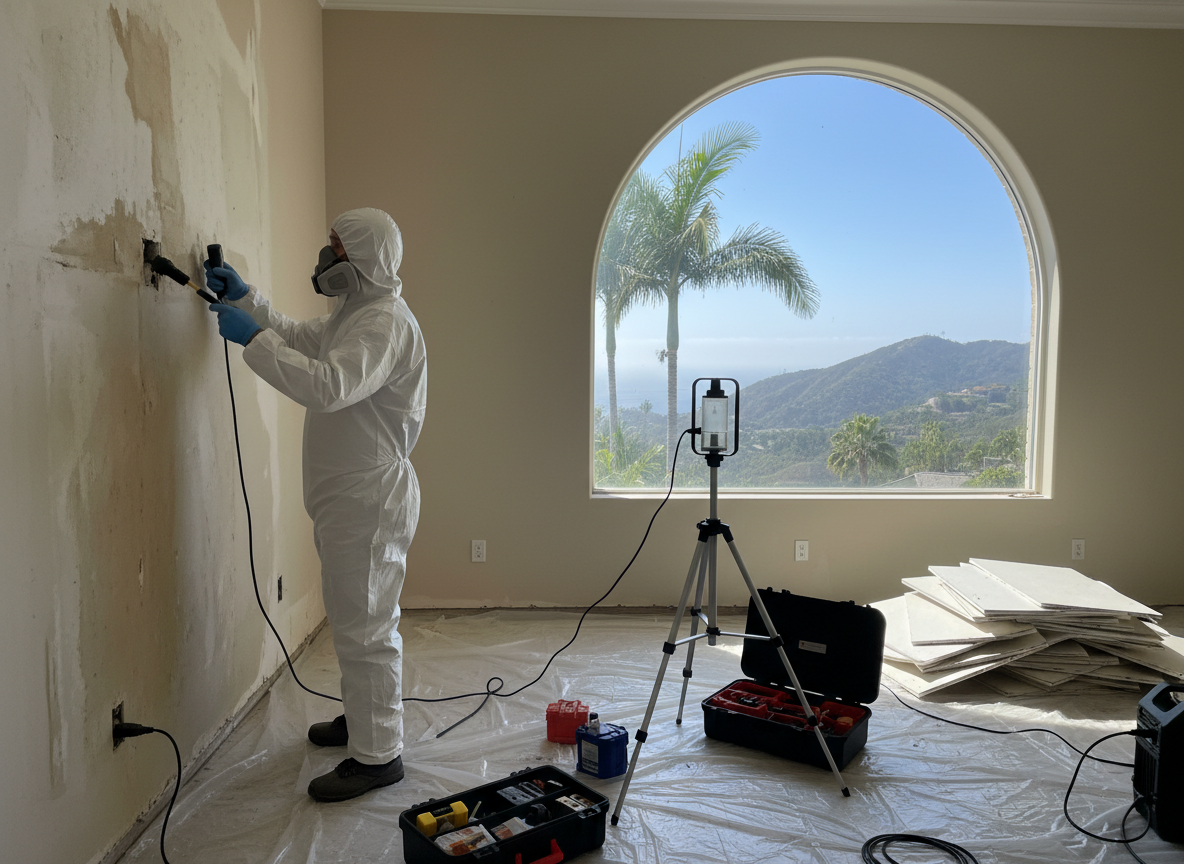
Pacific Palisades sits in Los Angeles County with a mild coastal Mediterranean climate where foggy mornings regularly push moisture into crawl spaces and attics of mid-century homes in The Village and Castellammare. Emergency mold testing begins with air and surface samples collected from multiple zones, including behind built-in cabinetry and under hardwood floors where water from roof leaks or hillside runoff often hides. Results return within 24 to 48 hours from an accredited lab, allowing owners to decide on containment before visible colonies spread to adjacent rooms.
Homes near Pacific Palisades Park and Temescu Park frequently sit on sloped lots where poor drainage channels rainwater against foundations. In these conditions technicians focus sampling on sill plates and lower wall cavities, areas that stay damp longer than flat lots in Santa Monica or Malibu. Testing also checks HVAC returns because coastal humidity can circulate spores through ductwork after a single heavy rain event.
Marquez Knolls properties built on fill soil sometimes experience micro-cracks in slabs that let groundwater vapor rise. Emergency protocols include moisture meter readings at multiple depths plus tape-lift samples from suspect drywall. This targeted approach prevents unnecessary demolition while confirming whether remediation is required under Los Angeles County health guidelines.
Owners who call from 960 Monument St dispatch receive same-day visits because morning fog can turn a small plumbing drip into widespread hidden growth within 48 hours. Documentation includes chain-of-custody forms and photos of every sample location so insurance adjusters see exactly where moisture originated.
Technician insight
In Pacific Palisades the thing that catches most people out with emergency mold testing services is the way morning fog sits in the canyons around Castellammare and keeps older wooden framing damp for days after a leak stops. Homeowners often open windows thinking fresh air helps, but that just circulates spores through the house before we can map the source.
Hidden Growth After Roof Leak Near Will Rogers Park
A Castellammare homeowner noticed musty smell in an upstairs closet two days after heavy rain. Inspection found elevated moisture along the north wall where a flashing detail had failed. Air samples from the closet and adjacent bedroom returned high Penicillium counts; surface samples confirmed active growth inside the wall cavity. Containment was installed the same afternoon and the source was dried before spores reached the rest of the 1960s ranch house.
How it works
- 1
Initial Phone Assessment
Technician records symptoms, recent water events, and property location to prepare the right sampling kit before leaving the Monument Street base.
- 2
On-Site Inspection and Sampling
Air pumps, swabs, and moisture meters are used in affected zones while noting construction type and ventilation paths typical of Pacific Palisades hillside homes.
- 3
Laboratory Analysis
Samples travel to a partner lab for spore identification and concentration counts, with results available the next business day.
- 4
Report Delivery and Next Steps
Written findings include photos, moisture readings, and clear recommendations for containment or further remediation if growth is confirmed.
Pricing
Upfront quote given after the initial inspection determines number of samples and access difficulty.