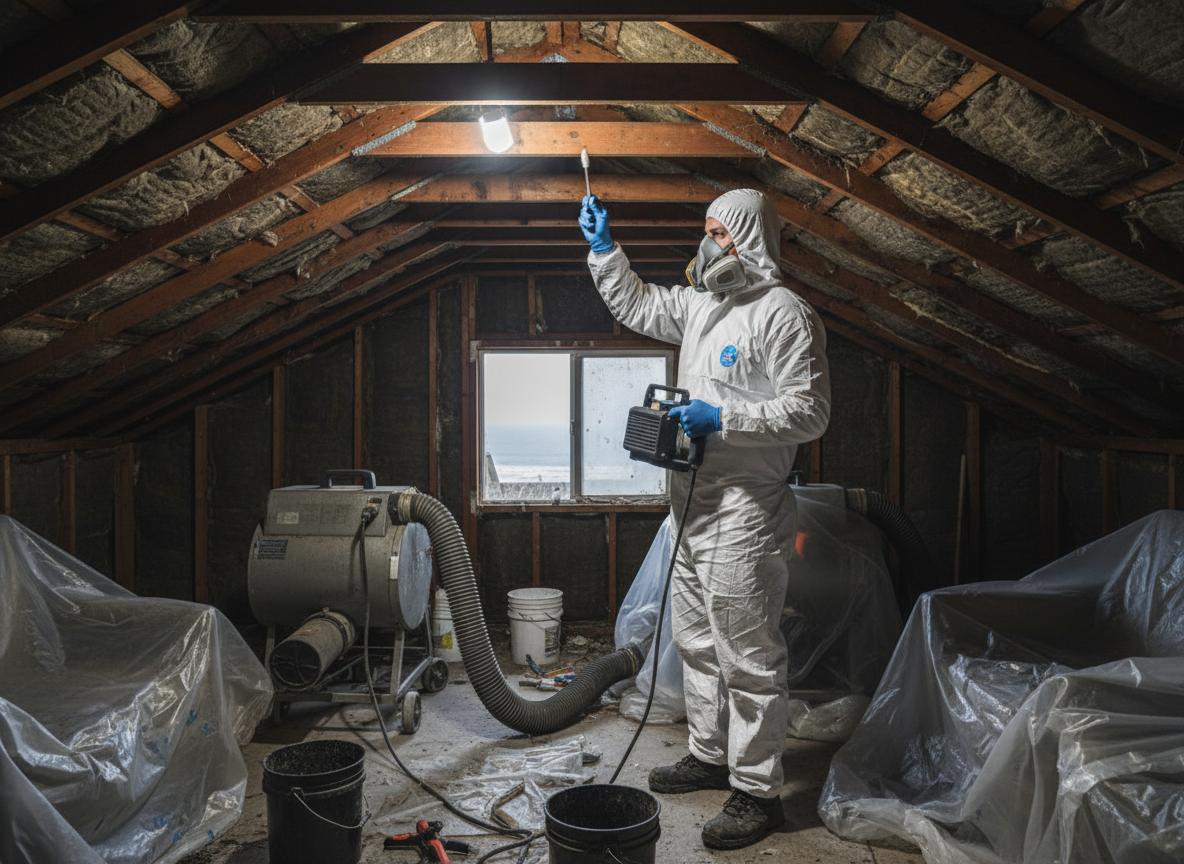
Pacific Palisades attics often trap moisture from the mild coastal Mediterranean climate and frequent foggy mornings that roll in from the Pacific. Homes in The Village and Castellammare frequently feature older roof decks and limited ridge venting, allowing condensation to form on sheathing during cooler nights. This creates conditions where mold colonies establish on cellulose insulation or OSB without visible ceiling stains below. Testing begins with moisture metering and air sampling at multiple attic points rather than a single location to map hidden growth along the north-facing slopes common in Marquez Knolls.
Removal work requires isolating the attic from living spaces with sealed poly barriers because many Pacific Palisades houses sit on steep canyon terrain where negative pressure can pull spores downward into bedrooms. Technicians remove affected insulation and treat rafters with antimicrobial solutions approved for California coastal conditions, then improve airflow by adding gable vents or solar-powered fans where code allows. Homeowners in Santa Monica-adjacent blocks sometimes discover that previous roof repairs used underlayment that trapped water against the decking, accelerating mold return within two seasons if the source is not corrected.
Los Angeles County building standards require proper disposal of contaminated materials and documentation of moisture source correction before re-insulation. Crews working near Will Rogers State Historic Park or Pacific Palisades Park routinely check for wildlife entry points around eaves, since raccoons and birds create openings that allow additional fog and rain intrusion. Final clearance testing uses both visual inspection and spore trap samples to confirm levels have returned to outdoor baselines before the attic is reopened.
Technician insight
In Pacific Palisades the thing that catches most people out with Attic mold testing and removal is the marine layer that keeps sheathing damp for weeks even after a roof leak is fixed; older homes in Castellammare and The Village often have single-layer roof decks with no ridge vent, so the fog condenses every night and mold restarts on the north slope before homeowners notice any ceiling spots.
Hidden Growth After Roof Patch in Marquez Knolls
A homeowner noticed musty odors after a minor roof repair. Inspection found condensation under the decking on the north slope where marine fog settled nightly. Contaminated batts were removed, rafters treated, and two gable vents added to restore airflow. Clearance samples matched outdoor baselines and the odor did not return.
How it works
- 1
Initial Moisture Assessment
Technicians map attic humidity and temperature differentials created by Pacific Palisades marine layer patterns using calibrated meters at multiple roof planes.
- 2
Targeted Air and Surface Sampling
Samples are collected from insulation, sheathing, and HVAC returns to identify mold types common after repeated foggy mornings.
- 3
Containment and Source Correction
Attic is isolated, leaks around flashing or vents near Castellammare slopes are documented, and affected materials are removed.
- 4
Antimicrobial Treatment and Ventilation Upgrade
Rafters are treated and additional venting is installed where terrain and roof pitch allow improved airflow.
- 5
Clearance Testing and Rebuild
Post-remediation samples confirm safe spore levels before new insulation is installed and the space is returned to service.
Pricing
Pricing varies with attic size, extent of hidden growth behind insulation, and any required ventilation upgrades on sloped Pacific Palisades lots.