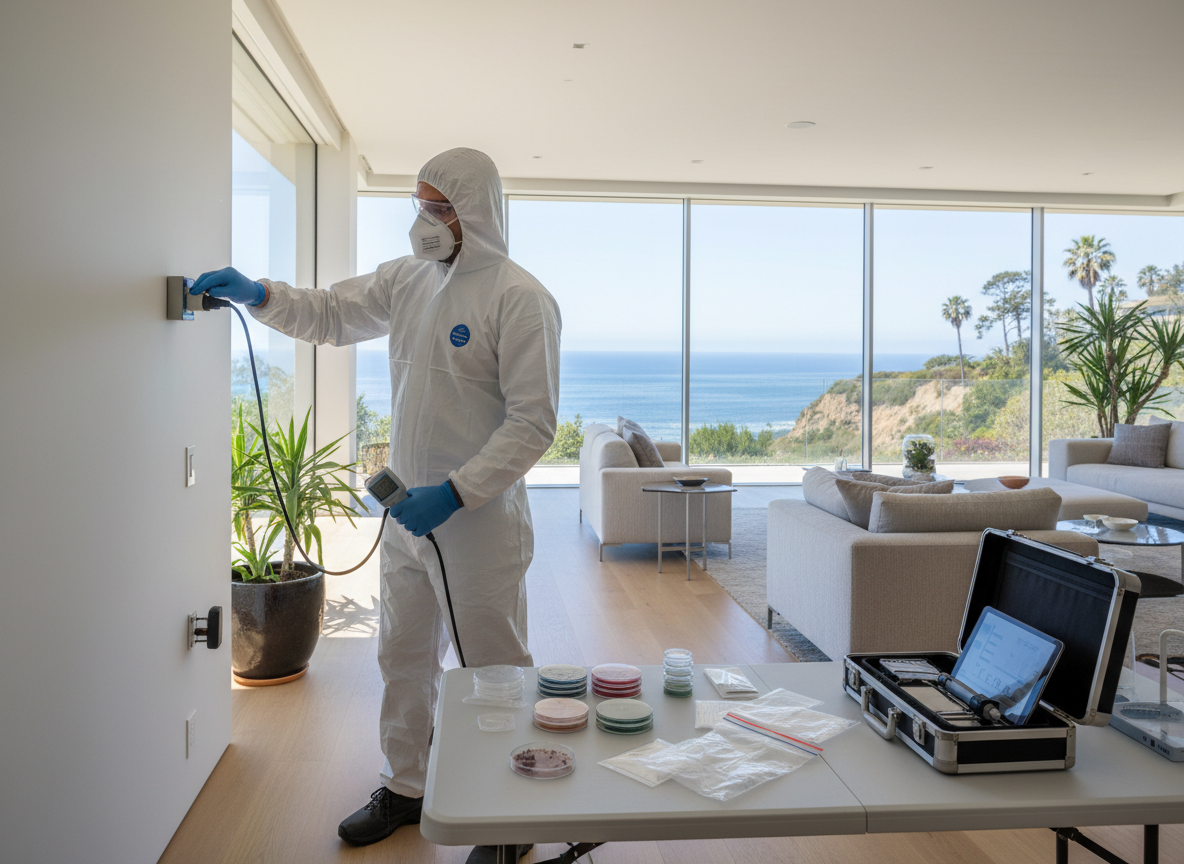
Pacific Palisades sits in Los Angeles County with a mild coastal Mediterranean climate that brings foggy mornings most of the year. These conditions create repeated condensation on cooler interior surfaces in homes built decades ago in Castellammare and Marquez Knolls. Air quality and mold testing here must account for salt air, limited attic ventilation, and hillside drainage that pushes water toward foundations. Technicians sample both living spaces and crawl areas because visible growth often hides behind plaster or under floorboards where coastal humidity lingers.
Testing protocols include spore trap sampling, moisture meter readings, and infrared scans to locate temperature differentials created by morning fog. In The Village, many mid-century homes have original ductwork that harbors hidden colonies when sea air infiltrates through unsealed joints. Results guide whether remediation stays localized or requires broader containment. Reports note specific locations and species so homeowners understand which areas need immediate attention versus ongoing monitoring.
Terrain plays a direct role. Steep lots in Marquez Knolls often have retaining walls that trap runoff against stucco walls, raising interior humidity levels. Testing crews check these transition zones first because standard room-by-room scans miss the pattern. Proximity to Santa Monica and Malibu means many properties share similar construction details, yet each lot’s exposure to prevailing winds changes how quickly moisture dries after fog lifts.
Homeowners receive chain-of-custody documentation for all samples sent to an independent lab. This step matters when insurance questions arise or when selling a property in Pacific Palisades where disclosure requirements are strict. Testing also covers HVAC systems because coastal air often carries particulates that accumulate in filters and coils, affecting overall indoor readings.
Technician insight
In Pacific Palisades, the thing that catches most people out with Air quality and mold testing is how morning fog settles into the older single-wall construction common in Castellammare; homeowners test only living rooms and miss the attic condensation that feeds growth behind knee walls.
Hidden Attic Growth After Window Leak
A homeowner in The Village noticed musty odors after winter rains. Inspection found elevated moisture in the attic above a repaired window. Air samples confirmed elevated spores; targeted removal and ventilation upgrades resolved the readings.
How it works
- 1
Initial Consultation
Discuss visible signs, recent leaks, and property history over the phone or at 960 Monument St.
- 2
On-Site Inspection
Technicians map moisture sources using meters and thermal imaging across all accessible areas.
- 3
Sample Collection
Air and surface samples taken from suspect zones plus control locations for lab analysis.
- 4
Report Delivery
Written findings with photos, lab results, and prioritized recommendations delivered within days.
Pricing
Pricing varies by square footage, number of samples, and access challenges typical of hillside lots; upfront quotes provided before work begins.