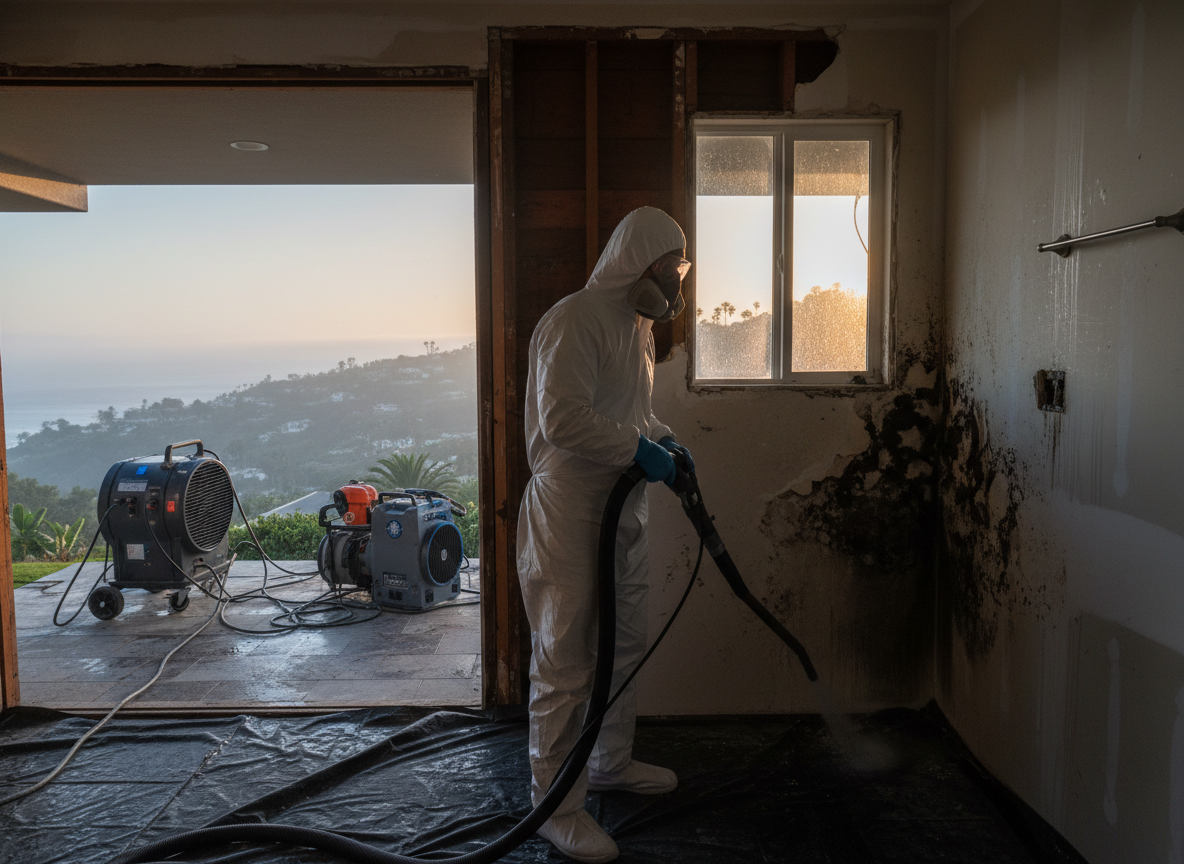
Pacific Palisades sits in a mild coastal Mediterranean climate where foggy mornings deposit moisture on north-facing walls and in crawl spaces of homes built before 1970 in neighborhoods like Castellammare and Marquez Knolls. These older wood-frame houses with single-pane windows and limited ventilation trap humidity that travels from the ocean through Temescu Park and up the canyons. When a sudden leak or roof penetration occurs, mold colonies can appear within 48 hours, especially in bathrooms and under kitchen sinks that back up against retaining walls.
Twenty-four hour mold removal here starts with rapid moisture mapping using infrared cameras to locate saturation behind plaster and in attic insulation without tearing out sound material. Containment follows immediately using negative air machines exhausted through windows facing Will Rogers State Historic Park to avoid spreading spores into adjacent rooms or neighboring homes in The Village. Removal includes HEPA vacuuming of affected drywall, disposal of porous materials, and application of EPA-registered antimicrobials on framing before drying begins with commercial dehumidifiers sized for the square footage.
Los Angeles County building codes require proper disposal of contaminated materials and documentation of moisture levels below 15 percent before any new finishes are installed. Homeowners near Santa Monica or Malibu often discover that hillside drainage issues from winter rains push water under slabs, creating recurring colonies that standard household fans cannot address. Our crews carry portable generators so work continues during power outages common after coastal storms.
Technician insight
In Pacific Palisades the thing that catches most people out with 24 hour mold removal is the way morning fog keeps crawl spaces under 1960s homes in Castellammare damp for weeks after a small leak, letting colonies spread behind stucco before any musty smell reaches the living areas.
Hidden Growth After Coastal Fog Event
A homeowner in Marquez Knolls noticed a ceiling stain following heavy morning fog. We found saturation extending into insulation above a bathroom shared with an exterior retaining wall. Containment was set, wet drywall and insulation removed, and the framing dried over two days. Clearance testing allowed repairs without further spread into adjacent bedrooms.
How it works
- 1
Emergency Response
Answer the call within minutes and dispatch a crew to the Pacific Palisades address to stop active water sources and begin containment.
- 2
Inspection and Mapping
Use moisture meters and thermal imaging to locate all affected areas in crawl spaces, attics, and wall cavities common to local hillside homes.
- 3
Containment and Removal
Isolate the work zone, remove saturated materials, and treat surfaces while exhausting air away from neighboring properties.
- 4
Drying and Verification
Run commercial drying equipment until moisture readings meet industry standards, then confirm clearance with independent testing.
Pricing
Cost depends on square footage affected, depth of hidden growth in older construction, and whether hillside access or after-hours work is required.